
Quick answer: LSZH (Low Smoke Zero Halogen) describes a cable material chosen when smoke visibility and the corrosivity of combustion gases matter — typically in enclosed, densely occupied or equipment-sensitive spaces. It is not a complete fire-performance classification. LSZH should never be described as fire-resistant, flame-retardant or circuit-integrity compliant unless separate test evidence for that exact product supports the claim.
Ask ten engineers what LSZH cable is and you will get ten answers — most of them close, several of them wrong in ways that matter at approval stage. “Low smoke zero halogen” is one of the most quoted acronyms in low-voltage cabling and one of the least verified. It appears on datasheets, in bills of quantities and in tender specifications, often with no test report attached and no statement of which standard, which edition, or which part of the cable was actually tested.
This article explains what LSZH genuinely means, which IEC test methods sit behind it, where the material is normally considered, and — most importantly — what the label does not prove. If you specify, approve or supply cable for hospitals, airports, data centers, tunnels or high-rise buildings, the distinctions below are the ones that come back at handover.
What Does “Low Smoke Zero Halogen” Actually Mean?
LSZH stands for Low Smoke Zero Halogen. It is used for cable compounds — sheath and, in some constructions, insulation — formulated to produce relatively little visible smoke and limited halogen-related combustion gases when burned under specified laboratory conditions.
Read that definition carefully, because three common assumptions are already excluded. LSZH does not mean the cable produces no smoke. It does not mean the cable contains literally zero halogen under every possible interpretation. And it says nothing at all about whether the circuit keeps working while the fire is burning.
“Low smoke” — a measured quantity, not a marketing adjective
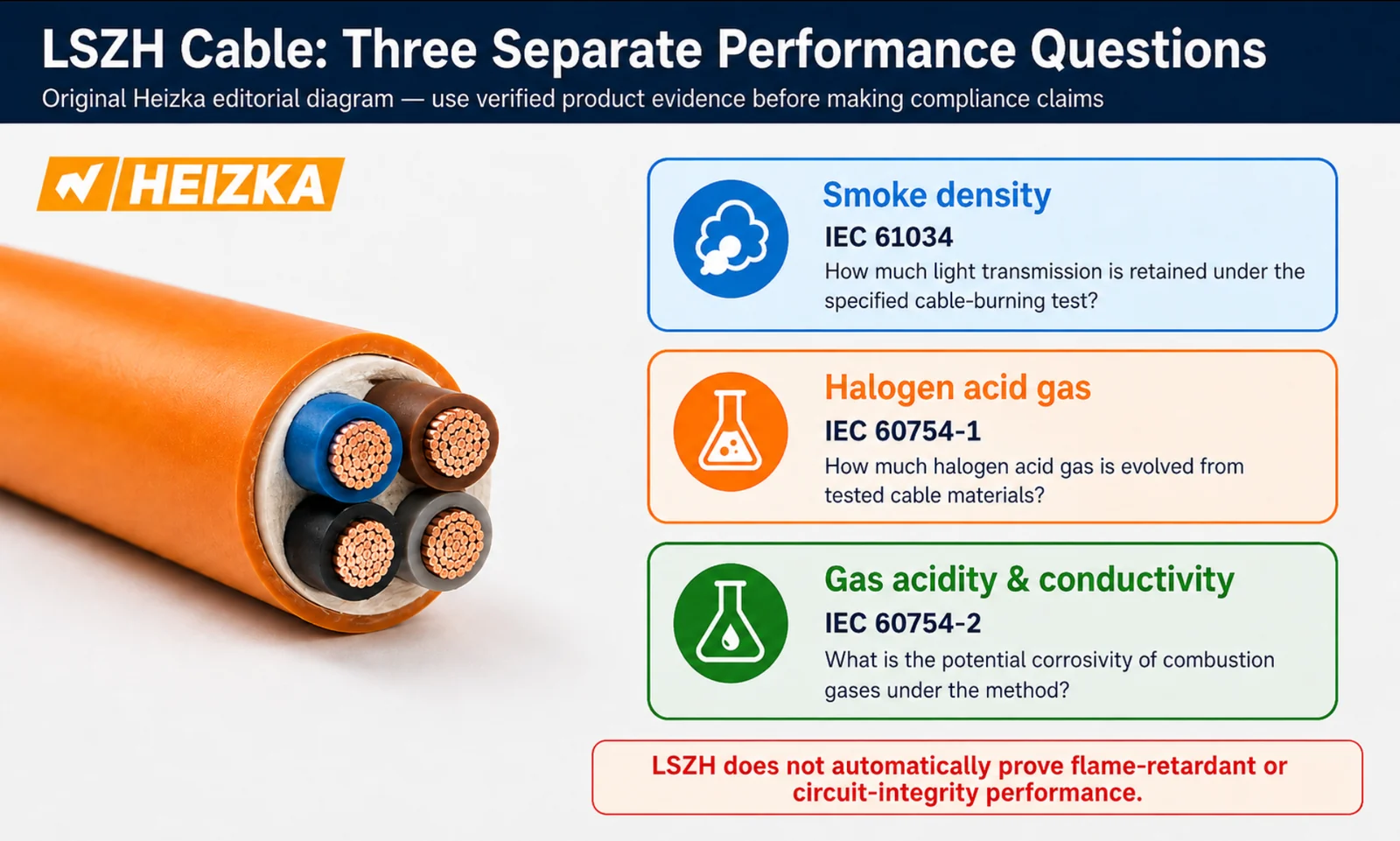
Smoke is a life-safety problem before it is a material problem: it reduces visibility, obstructs evacuation and makes firefighting harder. The IEC 61034 series is the reference method. IEC 61034-1 describes the test apparatus — the well-known three-metre cube — and IEC 61034-2 sets out the procedure and recommended requirements.
In practice, a cable sample is burned inside the chamber while a horizontal beam of white light crosses it and a fan circulates the air to mimic real conditions. What is recorded is how much of that light still reaches the receiver. A minimum light transmittance of 60 % is the figure most commonly written into LSZH specifications. That is a meaningful threshold — and it is also a reminder that “low smoke” is a percentage, not a promise.
“Zero halogen” — industry shorthand, not literal chemistry
Halogenated polymers such as PVC release acid gases when they burn. Those gases irritate the respiratory system and, once combined with moisture, corrode metals and electronic assemblies long after the fire is out. The IEC 60754 series addresses this in two complementary ways.
- IEC 60754-1 determines the halogen acid gas content evolved during combustion of cable materials. A widely used halogen-free threshold is ≤ 5 mg/g of HCl equivalent — set against roughly 150–350 mg/g for conventional PVC compounds.
- IEC 60754-2 evaluates the potential corrosivity of those gases by measuring acidity and conductivity. Criteria commonly specified for LSZH cables are pH ≥ 4.3 and conductivity ≤ 10 µS/mm.
Note the wording of the standards themselves: they are methods for determining values. Acceptance thresholds are set by the project specification, the local code or the cable specification — not by the acronym. Always confirm which criteria were applied, and to which edition of the standard.
The critical point is that these tests answer related but separate questions. A smoke-density result establishes nothing about halogen acid gas. A halogen-gas result establishes nothing about circuit integrity. A credible product page names the exact standard, part, edition and tested product scope rather than leaning on four letters.
How LSZH-Related Properties Are Evaluated
The table below is the one worth keeping open during a technical submittal review. The right-hand column is the one that saves projects.
| Property | Common IEC reference | What the test addresses | What it does not prove |
|---|---|---|---|
| Smoke density | IEC 61034-1 and IEC 61034-2 | Smoke emission and light transmittance under defined cable-burning conditions. | Circuit integrity, flame-spread class or suitability for every installation. |
| Halogen acid gas | IEC 60754-1 | Halogen acid gas evolved from the tested cable materials. | Smoke density or complete cable fire performance. |
| Gas acidity and conductivity | IEC 60754-2 | Potential corrosivity indicators of gases evolved from cable materials. | Electrical continuity during fire. |
| Flame propagation | Applicable part of IEC 60332 | Resistance to flame propagation under the stated test arrangement. | Circuit integrity under IEC 60331 or BS 6387. |
| Circuit integrity | IEC 60331 or BS 6387 where applicable | Continued electrical operation under defined fire-test conditions. | Low-smoke or halogen-gas performance unless separately tested. |
LSZH vs PVC Cable: Selection Factors, Not a Universal Winner
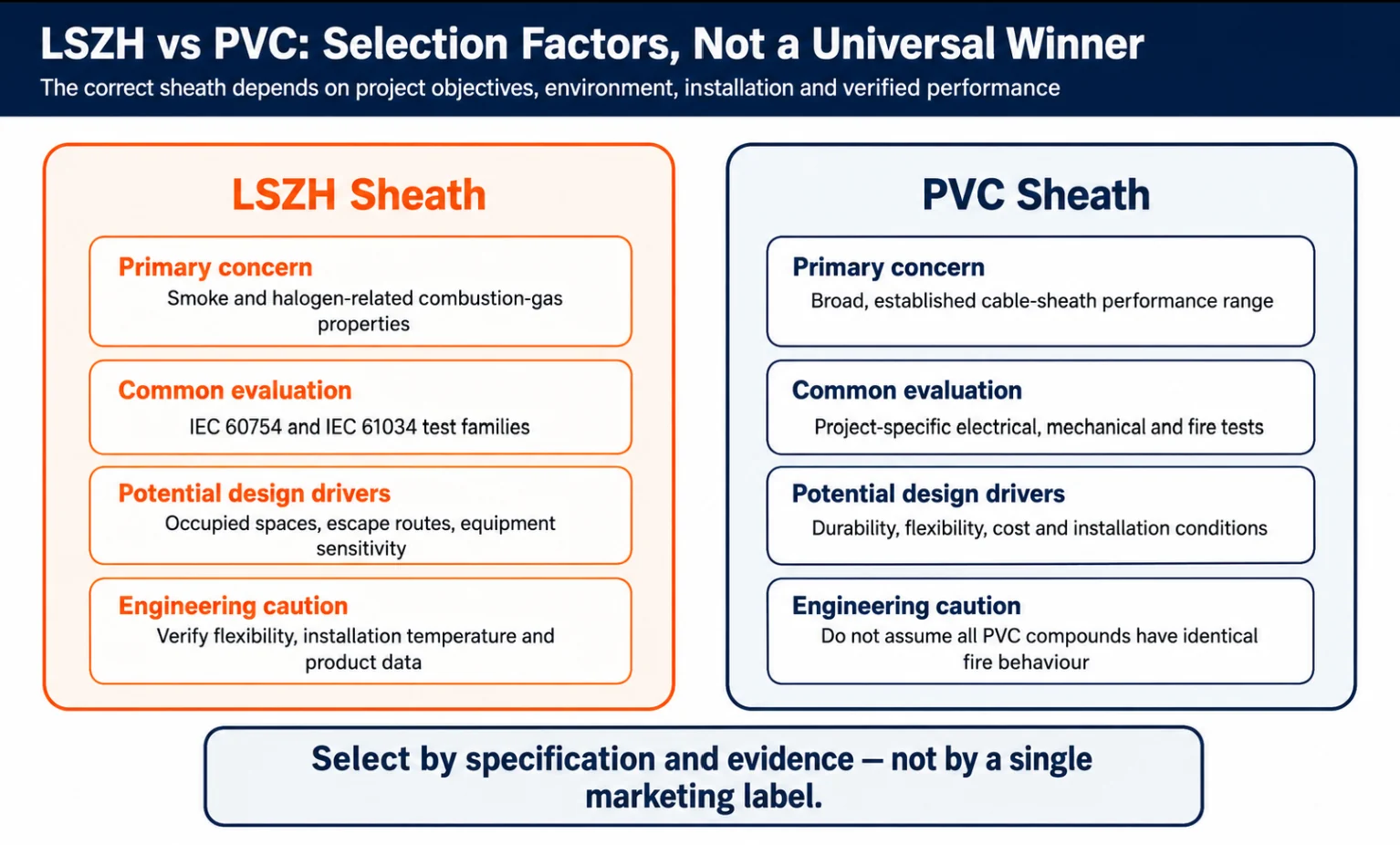
PVC remains one of the most widely used cable materials in the world, available in an enormous range of formulations and performance grades. LSZH compounds are selected when a project places particular weight on smoke visibility and on the corrosive effects of combustion gases. Neither description, on its own, defines the cable’s complete electrical, mechanical or fire performance.
It is a mistake — and a surprisingly common one — to assume every LSZH compound is automatically more flexible, more durable or better suited to every environment than PVC. Material behaviour varies by formulation. Installation temperature, minimum bend radius, abrasion resistance, chemical and UV exposure, expected service life and termination method should all be checked in the approved datasheet for the specific product, not inferred from the sheath type.
| Selection factor | Questions for LSZH | Questions for PVC |
|---|---|---|
| Fire-related objective | Which IEC 60754 and IEC 61034 evidence applies to the exact product? | Which fire-performance tests apply to the exact PVC compound and cable? |
| Installation environment | Are flexibility, temperature range and mechanical properties suitable? | Are smoke and combustion-gas characteristics acceptable for the project? |
| Occupied or enclosed spaces | Does the fire strategy require low-smoke and low-corrosivity materials? | Is PVC permitted by the specification and local requirements? |
| Documentation | Do catalogue, test report, marking and product page match? | Do catalogue, test report, marking and product page match? |
What LSZH Does Not Automatically Prove
If you take one section away from this article, make it this one. Six claims that an LSZH label does not support on its own:
- It does not mean “no smoke” — only reduced smoke under a defined test.
- It does not automatically prove flame-retardant performance.
- It does not automatically prove circuit integrity during fire.
- It does not prove compliance with BS 6387 or IEC 60331.
- It does not define conductor size, shielding, voltage rating or installation method.
- It does not make the cable suitable for every hospital, airport, tunnel or data center.
Editorial note: absolute wording such as “non-toxic”, “zero smoke”, “fireproof” or “safe in every fire” should be avoided entirely. State the exact test evidence and the scope of the claim instead.
Where Should LSZH Cable Be Used?
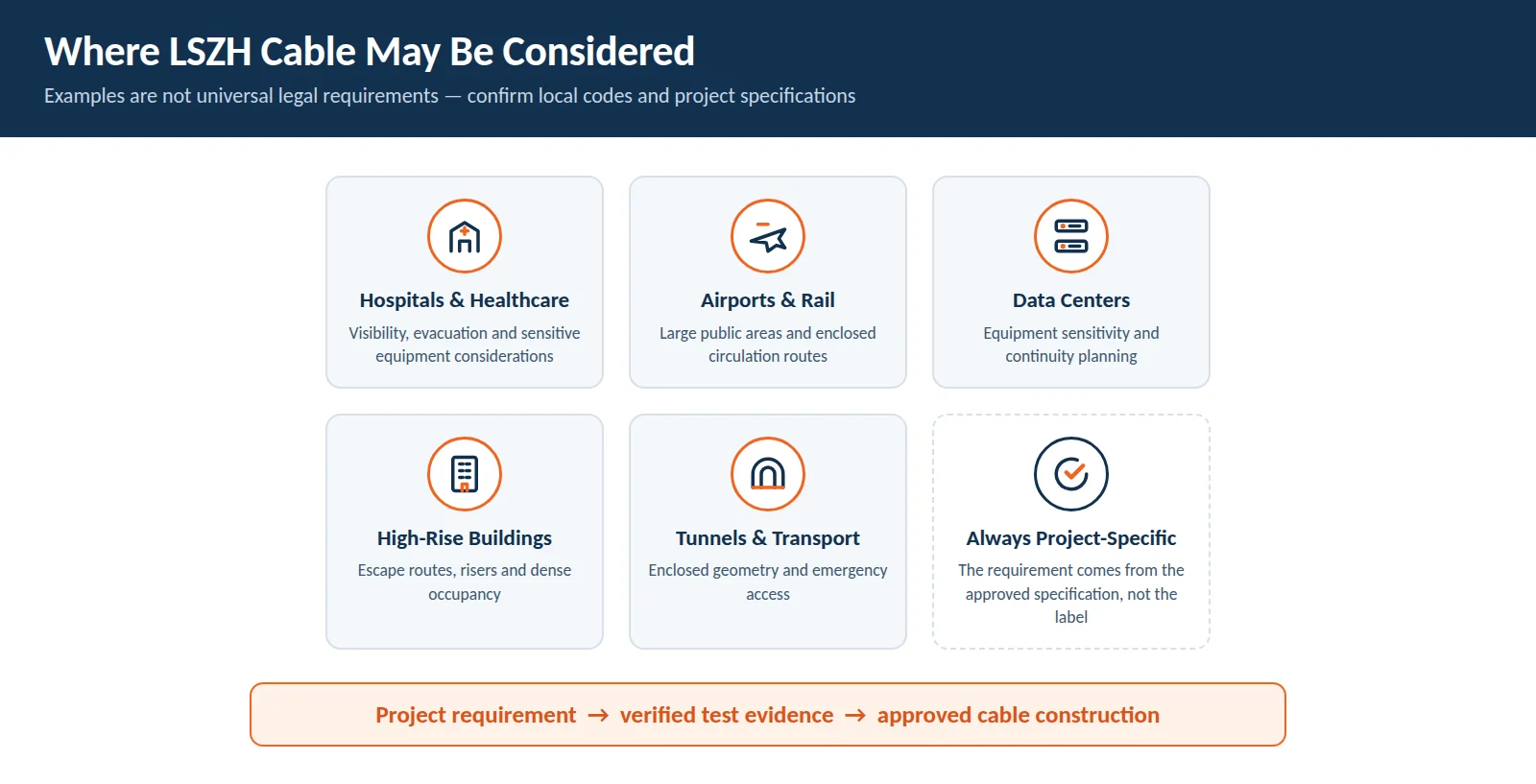
LSZH cable is commonly considered in enclosed, densely occupied or equipment-sensitive environments — places where smoke obscuring an escape route, or corrosive gas settling on electronics, would carry a disproportionate cost. Typical examples include hospitals, airports, rail stations, data centers, high-rise buildings and tunnels.
These are examples, not universal legal requirements. The correct material must be determined from the local code, the fire strategy, the approved project specification, the system requirements and the cable manufacturer’s verified technical data — in that order.
| Environment | Why LSZH may be considered | Additional checks |
|---|---|---|
| Hospitals and healthcare | Evacuation of dependent occupants, occupied spaces and sensitive equipment. | Fire strategy, circuit function, cleaning chemicals, routing and approvals. |
| Airports and rail stations | Large public areas and enclosed circulation routes. | Local transport standards, fire zones, route support and system continuity. |
| Data centers | Concern about corrosive gases near dense electronics. | Bandwidth, cable class, airflow, containment and business-continuity design. |
| High-rise buildings | Risers, escape routes and dense occupancy. | Local building code, shaft design, fire stopping and cable supports. |
| Tunnels and transport | Enclosed geometry and constrained emergency access. | Project-specific smoke, toxicity, fire and mechanical requirements. |
How to Verify an LSZH Cable Claim
The letters “LSZH” on a web page are not technical approval. Verification has to be based on the exact product, its construction and its supporting documents. Six steps, in order:
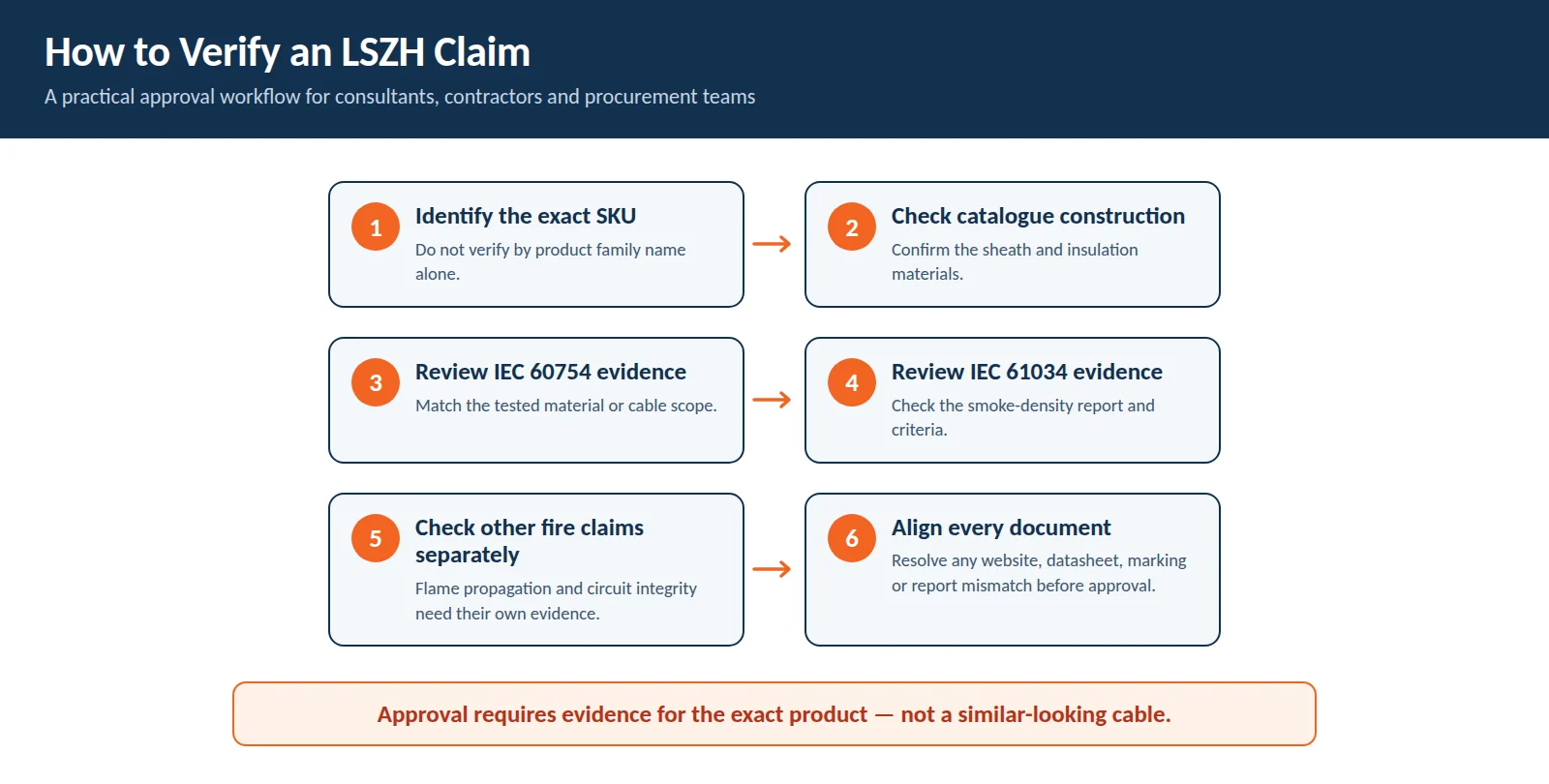
- Identify the exact product name, model and SKU. A product family name is not enough — constructions differ within a family.
- Check the sheath and insulation materials shown in the latest approved catalogue, not in an archived PDF.
- Review the applicable IEC 60754-1 and IEC 60754-2 evidence and confirm the tested material or cable scope matches what is being supplied.
- Review the applicable IEC 61034-1 and IEC 61034-2 evidence, including the criteria applied to the result.
- Verify flame-propagation and circuit-integrity claims separately. They need their own reports.
- Confirm consistency across website, catalogue, datasheet, product marking and test report. Resolve every mismatch before approval.
Heizka publishes catalogues, datasheets and compliance documents openly in the Heizka Resource Center and the project documents library, so steps 2 to 4 can be completed without a registration wall.
LSZH and Fire-Resistant Cables: Related, Not Interchangeable
A cable can be both LSZH and fire-resistant — but the two properties must be demonstrated separately, because they are measured by different methods against different criteria. For a life-safety circuit, a designer may need evidence of all four: low smoke, limited halogen-related gases, resistance to flame propagation, and circuit integrity. Which of those apply, and to what level, depends on the system and the project specification. If the flame-retardant / fire-resistant distinction is the part causing confusion, our companion article on fire-resistant cable vs flame-retardant cable covers it in detail.
Heizka supplies fire-resistant cable configurations with LSZH sheaths. Before any individual product is specified, reconcile the product name, shielding description, conductor size, applicable standards and downloadable documents against the latest approved catalogue — the Heizka fire-resistant cable range is the correct starting point for that check. Where the circuit also carries data or signalling, see shielded vs unshielded fire-resistant cable before fixing the construction.
Six Specification Mistakes Worth Avoiding
- Using “LSZH” as a substitute for a complete fire-performance specification.
- Describing LSZH cable as fireproof or non-toxic.
- Copying IEC 60754 or IEC 61034 claims from one SKU to another.
- Confusing IEC 60754 (combustion gases) with IEC 60751 (platinum resistance thermometers) — a single digit, an entirely different subject.
- Assuming an LSZH sheath proves the entire cable construction passed every listed test.
- Selecting a cable by sheath material without checking electrical and mechanical requirements.
Frequently Asked Questions
What does LSZH stand for?
LSZH stands for Low Smoke Zero Halogen. It describes cable materials intended to limit visible smoke and halogen-related combustion gases under specified test methods.
Does LSZH cable produce no smoke?
No. “Low smoke” is not the same as “no smoke”. Performance is assessed under the applicable test method, commonly the IEC 61034 series, where a minimum light transmittance such as 60 % is typically specified.
Is LSZH cable fire-resistant?
Not automatically. Circuit integrity must be supported by a separate test such as the applicable part of IEC 60331 or BS 6387.
Is LSZH the same as flame-retardant?
No. Flame propagation is assessed separately, commonly under the applicable IEC 60332 test method. See fire-resistant vs flame-retardant cable for the full comparison.
What is the difference between IEC 60754 and IEC 61034?
IEC 60754 addresses gases evolved from cable materials — halogen acid gas content in Part 1, and acidity and conductivity in Part 2. IEC 61034 addresses smoke density from cables burning under defined conditions.
Is LSZH always better than PVC?
No single sheath material is universally better. Selection depends on fire objectives, installation conditions, mechanical requirements, cost, system needs and verified product performance.
Where is LSZH cable commonly specified?
It is often considered in enclosed, occupied or equipment-sensitive environments such as hospitals, airports, data centers, high-rise buildings and tunnels. The actual requirement must come from the applicable project specification and local rules.
What documents should be checked before approval?
Check the current catalogue, the datasheet, the exact test report, the product marking, and any approval documents required by the consultant or the authority having jurisdiction.
Request Technical Support
To review an LSZH cable requirement with our technical team, send us the system type, installation environment, applicable standards, conductor size, shielding requirement, circuit function and the approval documents you need. The more of that detail arrives up front, the faster a verified answer comes back.
Primary Technical Sources
- IEC 60754-1:2011+AMD1:2019 — Determination of the halogen acid gas content from cable materials.
- IEC 60754-2:2011+AMD1:2019 — Determination of acidity (by pH measurement) and conductivity of combustion gases.
- IEC 61034-1:2005+AMD1:2013+AMD2:2019 — Smoke-density test apparatus.
- IEC 61034-2:2005+AMD1:2013+AMD2:2019 — Smoke-density test procedure and requirements.
- BS 6387:2013 — Circuit-integrity context; not an LSZH test.
Standard numbers, editions and criteria cited above are provided for orientation. Always verify the edition in force and the acceptance criteria stated in your project specification, and confirm the test evidence issued for the exact product supplied.
Technical Review by John Smith
Cable Product Engineer
12 Years in Structured Cabling & Low Voltage Systems
This article is general technical guidance and does not replace the approved project specification, the local code, or the test evidence issued for a specific product.