Heizka Fire Cable
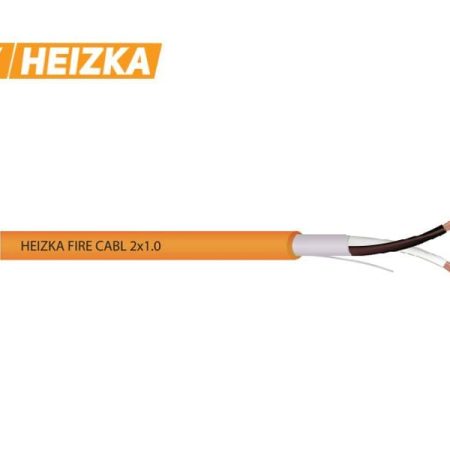
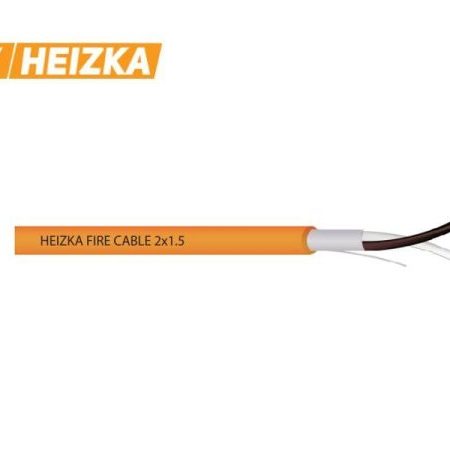
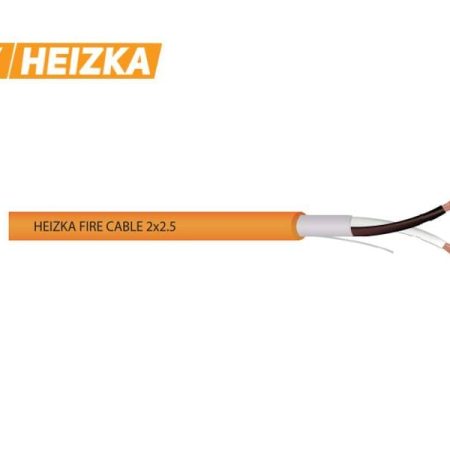
Heizka Fire Cable is a range of fire-resistant, low smoke zero halogen (LSZH) cables built for circuits that must keep functioning while a building is on fire. It is supplied in three two-core sizes — 2×1.0 mm², 2×1.5 mm² and 2×2.5 mm² — each in shielded and unshielded construction. All six variants share the same build: stranded bare copper conductors, silicone insulation at 100% coverage, an orange LSZH jacket, and a 300 V rating with 2000 V dielectric strength.
Integrity for Highest Safety Standards
The range is built to achieve high fire-performance classes and is designed to meet BS 6387 C/W/Z — up to 950 °C for 180 minutes, plus water spray and mechanical shock — along with IEC 60331 for circuit integrity under fire, EN 50200 PH120 for 120-minute fire survival on small cables, IEC 60332-3 for limited flame spread, and IEC 60754 and IEC 61034 for low acidity, corrosivity and smoke density. The intent is stable power and signal transmission under fire conditions, which is why the range is specified for data centers, hospitals, airports, high-rise buildings and tunnels. Consistent quality, precise manufacturing and strict QA support long service life.
The product datasheets cite IEC 60331-1, IEC 60332-1, EN 50200, EN 61034-2, BS 5839-1, BS 6387 and CNS 11175, plus ISO 9001 and RoHS compliance. Note that the per-product listings cite BS 6387 and EN 50200 without printing category letters or a PH classification. Because fire performance is a safety claim, confirm the exact standard, part, edition and category for the SKU against current test documentation before submittal.
What Each Standard Actually Measures
Fire-resistant and flame-retardant are not synonyms; the two properties are tested separately. IEC 60331 assesses circuit integrity — whether the cable keeps carrying its circuit during a defined fire exposure, combined with mechanical shock. IEC 60332 assesses flame propagation, and a single-cable result under IEC 60332-1 does not demonstrate bunched-cable performance under IEC 60332-3. BS 6387 designates fire, fire with water and fire with mechanical shock protocols, which is where the C, W and Z letters come from. LSZH describes smoke and halogen behavior; it does not prove circuit integrity. Our article on fire-resistant versus flame-retardant cable sets out the distinction.
Shielded or Unshielded
Both constructions carry the same fire-performance intent; the shield is an electromagnetic compatibility decision, not a fire-performance upgrade. The shielded variants use a polyester tape plus aluminum foil screen at 100% coverage with a 7/0.18 tinned copper drain wire. Specify shielded where the route runs parallel to power feeders or busways, passes through plant rooms with variable frequency drives, or where the panel manufacturer requires it. Unshielded is normally sufficient with proper separation from power conductors, and its lower mutual capacitance can matter on long addressable loops. Bond the screen at the control panel end only, keep the drain wire continuous, and never use it as a grounding conductor. See shielded versus unshielded fire-resistant cable.
Published Construction Data by Size
Conductor sizeStrandingInsulation diameterMax. DC resistance at 20 °CJacket OD, unshieldedJacket OD, shielded
2×1.0 mm²16/0.24 mm2.1 ± 0.10 mm21.4 Ω/km5.6 ± 0.3 mm5.7 ± 0.3 mm
2×1.5 mm²30/0.24 mm2.5 ± 0.10 mm12.33 Ω/km6.6 ± 0.3 mm6.7 ± 0.3 mm
2×2.5 mm²49/0.24 mm3.1 ± 0.10 mm7.98 Ω/km8.0 ± 0.3 mm8.1 ± 0.3 mm
All sizes are rated 300 V, tested at 2000 V dielectric strength, with 150% elongation at break and 10 N/mm² tensile strength. Standard packaging is 500 m per reel with sequential footage markers. Operating temperature ranges are published per SKU and are not uniform across the range, so read that figure from the datasheet for the exact item ordered.
Frequently Asked Questions
Does an LSZH jacket make a cable fire-resistant?
No. LSZH describes smoke emission and halogen content when the compound burns. Circuit integrity is a separate property demonstrated by a separate test, such as IEC 60331 or EN 50200.
Can I apply one SKU’s test evidence to a different conductor size?
No. Fire test results apply to the tested construction. Moving between cross-sections changes conductor, insulation and jacket dimensions, so the evidence must cover the size installed.
Which size should I use for a detector loop?
Detector and addressable loops run at low quiescent current, where 2×1.0 mm² is the common choice. Sounder circuits move up to 2×1.5 mm² or 2×2.5 mm² once volt drop is calculated.
Where do I get the datasheets and certificates?
Catalogs, datasheets and compliance certificates download from Project Documents, no registration required. Request any tender document not listed.
For pricing, lead time, reel configuration or a submittal document pack, send the part number, quantity and destination through contact us. Include the governing specification and required fire-performance category so the team can confirm the correct construction and supply matching test documentation before you commit the order.