
Fire-resistant cable vs flame-retardant cable is one of the most common points of confusion in cable specification. Both cable types are designed to improve safety during a fire, but they do not perform the same function, and the two terms should not be used interchangeably.
A flame-retardant cable is designed to resist or limit the spread of flame along the cable. A fire-resistant cable, by contrast, is designed to continue carrying electrical power or signals while it is exposed to the conditions defined by an applicable fire test.
This distinction is particularly important in fire alarm, emergency communication, smoke-control, evacuation and other life-safety systems. Selecting the wrong cable category can result in a circuit that limits flame spread but stops operating when the system is needed most.
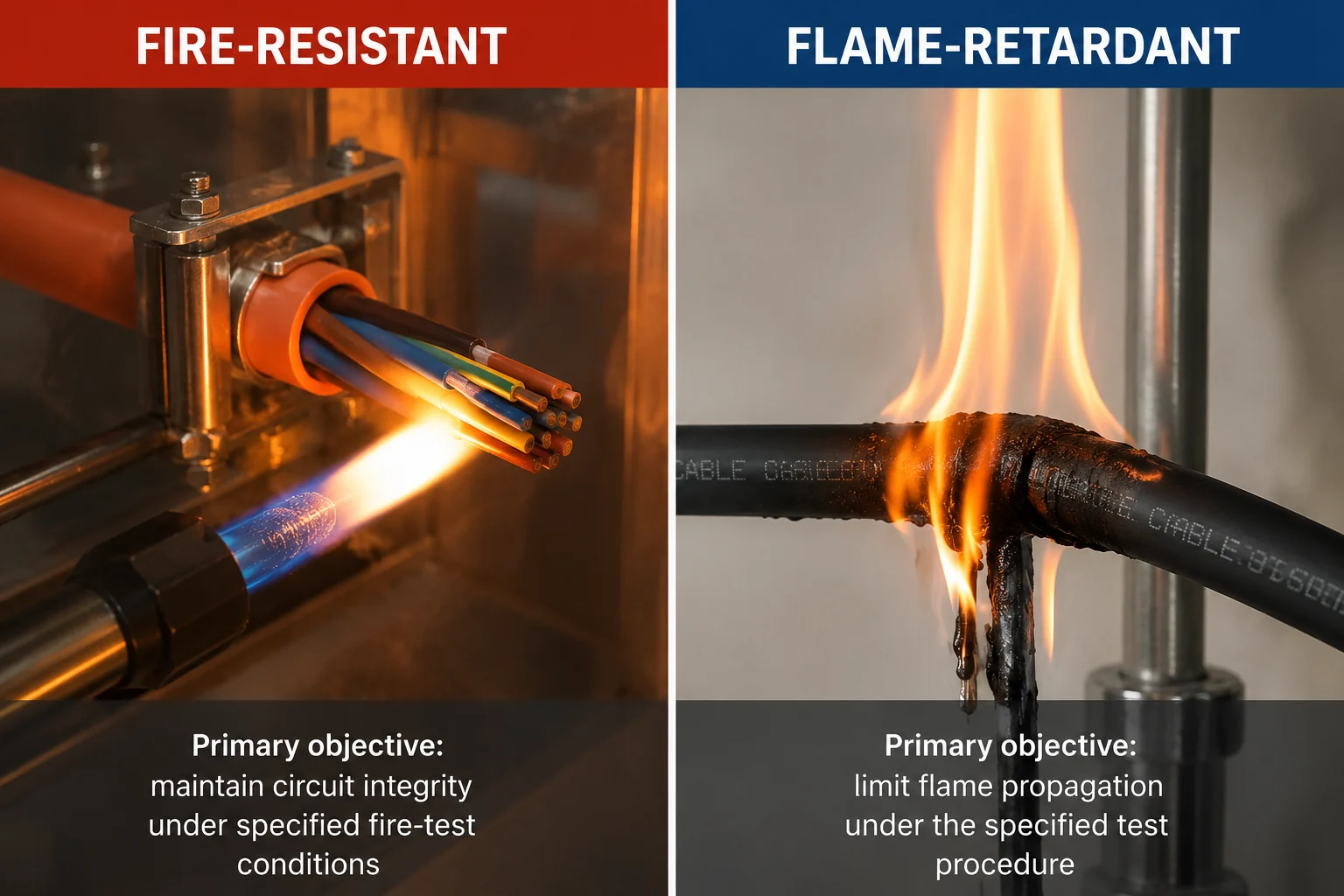
Table of Contents
- Fire-Resistant vs Flame-Retardant in One Minute
- What Is a Fire-Resistant Cable?
- What Is a Flame-Retardant Cable?
- Why Flame Propagation Is Not the Same as Circuit Integrity
- Can a Cable Be Both Fire-Resistant and Flame-Retardant?
- Fire-Resistant, Flame-Retardant and LSZH Are Different Terms
- Key Standards to Understand
- How to Select the Correct Cable
- Common Specification Mistakes
- How to Verify a Cable Before Approval
- Heizka Fire-Resistant Cable Options
- Frequently Asked Questions
- Choose Cable Performance Based on the Required Function
- References and Source Notes
Fire-Resistant Cable vs Flame-Retardant Cable in One Minute
| Comparison point | Fire-resistant cable | Flame-retardant cable |
|---|---|---|
| Primary objective | Maintain circuit integrity during specified fire-test conditions | Limit flame propagation along the cable under the specified test procedure |
| Main question | Can the circuit continue operating during the test? | How far does the flame spread under the test conditions? |
| Typical test families | BS 6387 and IEC 60331 series | IEC 60332 series |
| Common applications | Fire alarms, emergency communications, smoke control and other critical safety circuits | Electrical, control and communication systems requiring reduced flame propagation |
| Evidence required | Test report or certificate covering the exact cable and applicable circuit-integrity test | Test report covering the relevant flame-propagation procedure |
| Can it replace the other type? | Not automatically | Not automatically |
The IEC 60331 series covers cables required to maintain circuit integrity under specified fire and mechanical-shock conditions, while IEC 60332-1-2 addresses vertical flame propagation for a single insulated wire or cable. BS 6387:2013 is a current British Standard covering a test method for cables required to maintain circuit integrity under fire conditions.[1][2][3][4]
What Is a Fire-Resistant Cable?
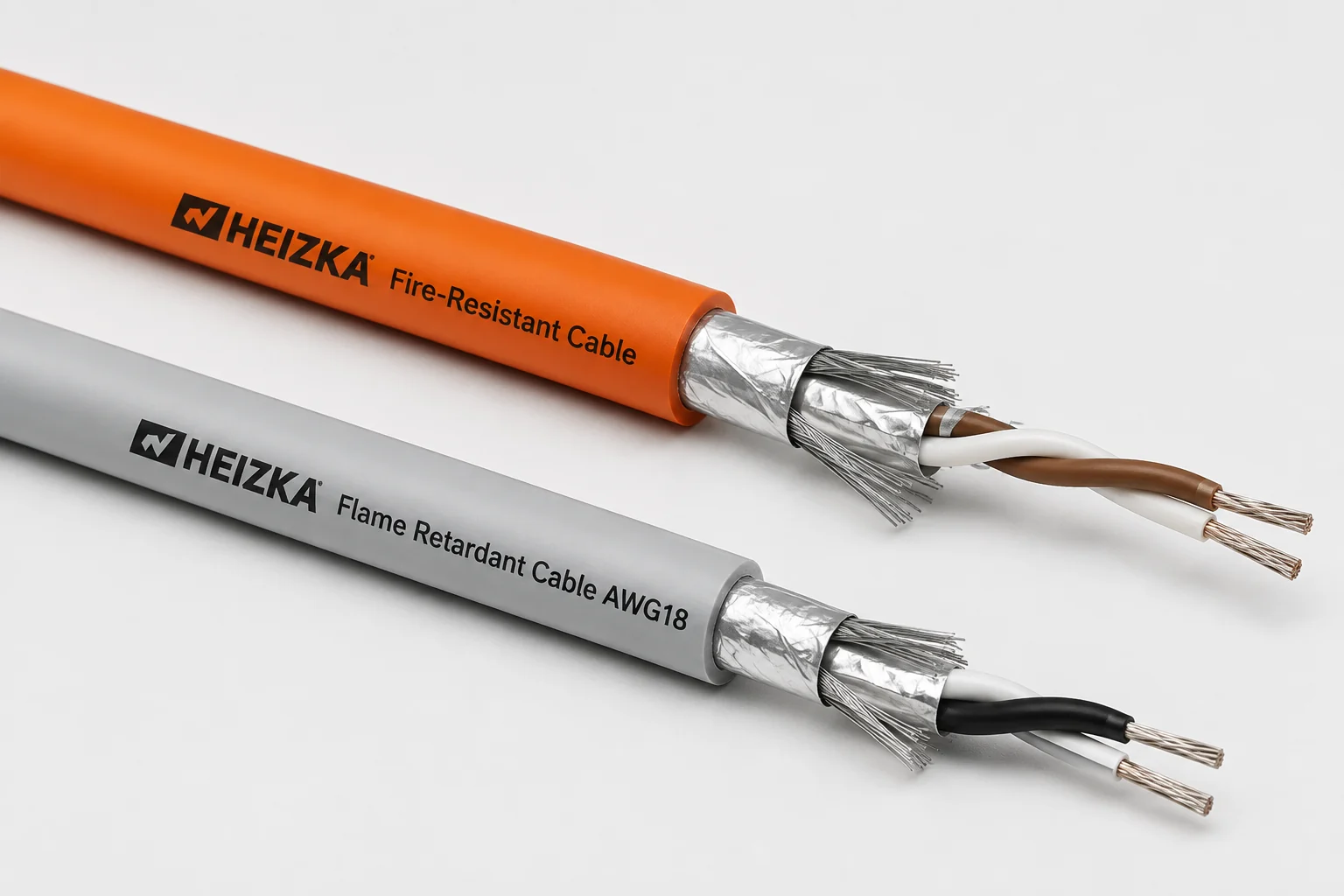
A fire-resistant cable is designed to maintain electrical continuity or signal transmission while being subjected to a specified fire test. The key concept is circuit integrity.
During the test, the cable is energised or continuously monitored. To pass, it must continue performing its intended electrical function for the required test duration and under the conditions defined by the applicable standard.
Depending on the project and standard, the test programme may involve:
- Fire exposure.
- Fire combined with mechanical shock.
- Fire combined with water.
- A defined temperature and test duration.
- Specific cable mounting, energisation and continuity-checking arrangements.
BS 6387:2013 applies within a defined voltage and cable-diameter scope. IEC 60331-1:2018 and IEC 60331-2:2018 distinguish between cables above and at or below 20 mm overall diameter, respectively, for the stated test methods.[1][2][3]
Fire-resistant performance should therefore never be treated as an unlimited property. A cable demonstrates performance under the precise conditions of the test it has passed. The term “fireproof cable” should generally be avoided because it can imply resistance to every possible real-world fire scenario.
Typical Applications
Fire-resistant cables may be considered for circuits that need to continue operating during an emergency, including:
- Fire detection and alarm systems.
- Voice evacuation and emergency communication systems.
- Emergency lighting circuits.
- Smoke-control and smoke-extraction systems.
- Firefighting equipment interfaces.
- Critical signalling and monitoring circuits.
- Other life-safety systems defined by the approved project specification.
The final cable selection must follow the system design, applicable regulations, consultant requirements, equipment-manufacturer instructions and approved fire strategy.
What Is a Flame-Retardant Cable?
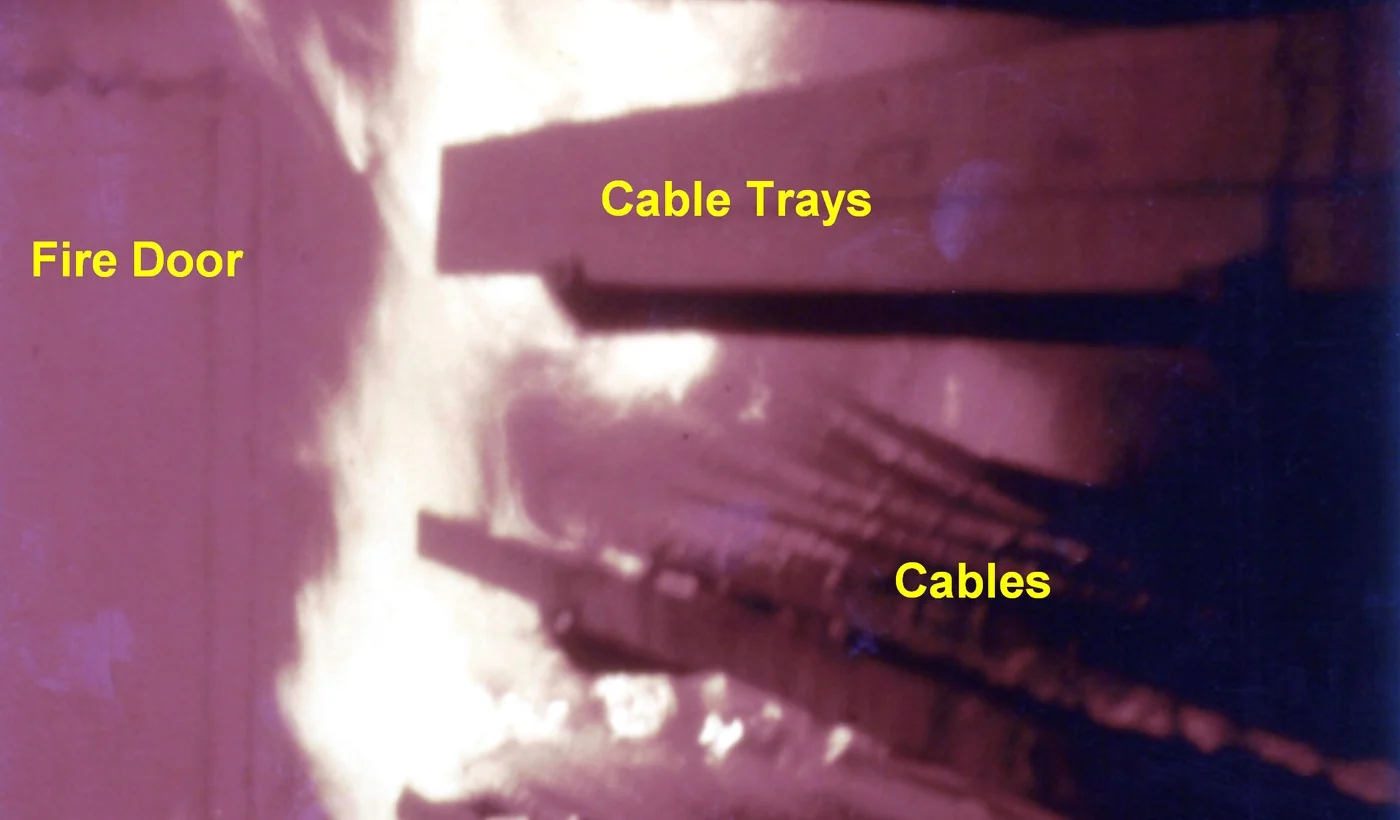
A flame-retardant cable is designed to resist ignition or limit the propagation of flame along its length under a specified test method. The principal objective is not necessarily to keep the circuit operating. Instead, it is to reduce the cable’s contribution to flame spread.
IEC 60332-1-2:2025 specifies a procedure for testing resistance to vertical flame propagation on a single vertical insulated conductor, cable or optical-fibre cable using a 1 kW premixed flame. The standard also notes that performance in a single-cable test does not by itself demonstrate compliance for cables installed together as a group; bunched-cable testing is addressed by the IEC 60332-3 series.[4][5]
A cable may therefore meet a flame-propagation requirement while losing electrical continuity during direct fire exposure. This does not mean that flame-retardant cable is inferior. It simply addresses a different safety objective.
Typical Applications
Flame-retardant cables are widely considered in installations where the project specification requires reduced flame propagation, including building electrical systems, control circuits, communication systems, data cabling, industrial equipment and cable-tray installations.
The applicable test category must be confirmed for the actual installation. A test for a single cable should not automatically be treated as equivalent to a test for grouped or bunched cables.
Why Flame Propagation Is Not the Same as Circuit Integrity
Consider a fire alarm notification circuit supplying sounders or visual alarm devices.
A flame-retardant cable may help reduce the spread of flame along the cable route. However, if its conductors fail and the circuit opens during the fire, the connected alarm devices may stop operating.
A fire-resistant cable is selected when the system requires the electrical circuit to remain functional for a specified period under defined fire conditions.
Two different questions
Flame retardancy asks: “Does the cable limit flame propagation?” Fire resistance asks: “Does the circuit continue operating during the specified fire test?” A project may require one or both properties.
Can a Cable Be Both Fire-Resistant and Flame-Retardant?
Yes. A cable can be designed and tested for both circuit integrity and flame propagation. Compliance must, however, be supported by separate and relevant evidence.
For example, a product may have:
- A circuit-integrity test report under the applicable part of IEC 60331.
- A BS 6387 test report for the stated protocol or category.
- A flame-propagation test report under an applicable part of IEC 60332.
- Separate smoke-density and combustion-gas test reports under other standards.
One certificate should not be interpreted as evidence for every fire-performance property. The exact product code, conductor size, construction, sheath material and cable diameter shown in the report must correspond to the product being supplied.
Fire-Resistant, Flame-Retardant and LSZH Are Different Terms
LSZH means Low Smoke Zero Halogen. It relates to smoke and combustion-gas properties of cable materials. It does not automatically prove circuit integrity, flame-spread performance to every IEC 60332 category, or suitability for every emergency circuit.
A cable may be LSZH and flame-retardant, LSZH and fire-resistant, or tested for all three groups of properties. Each claim requires the appropriate supporting evidence.
| Term | What it primarily describes | What it does not automatically prove |
|---|---|---|
| Fire-resistant | Circuit integrity during a specified fire test | Flame-spread category, LSZH properties or suitability for every system |
| Flame-retardant | Resistance to flame propagation under a specified procedure | Continued circuit operation during fire |
| LSZH | Smoke and halogen-related properties of cable materials | Circuit integrity or every flame-propagation classification |
Key Standards to Understand
BS 6387
BS 6387:2013 provides a test method for resistance to fire of cables required to maintain circuit integrity under fire conditions. It applies within the cable voltage, construction and diameter scope stated by BSI.[1]
It includes separate test concepts relating to resistance to fire alone, fire with water and fire with mechanical shock. A claim such as “BS 6387 CWZ” should only be used when the exact cable has supporting evidence covering the required protocols.
IEC 60331
The IEC 60331 series covers test methods for cables required to maintain circuit integrity under specified fire conditions. Different parts apply according to cable dimensions and test arrangement. IEC 60331-1:2018 addresses cables exceeding 20 mm overall diameter, while IEC 60331-2:2018 addresses cables not exceeding 20 mm overall diameter for the respective fire-with-shock test methods.[2][3]
A product page should therefore show the exact applicable part, not simply state “IEC 60331 compliant” without further detail.
IEC 60332
The IEC 60332 series addresses flame-propagation testing for electrical and optical-fibre cables. The series includes different procedures for single cables and vertically mounted bunched cables, so the applicable part and category should be identified in technical documentation.[4][5]
How to Select the Correct Cable
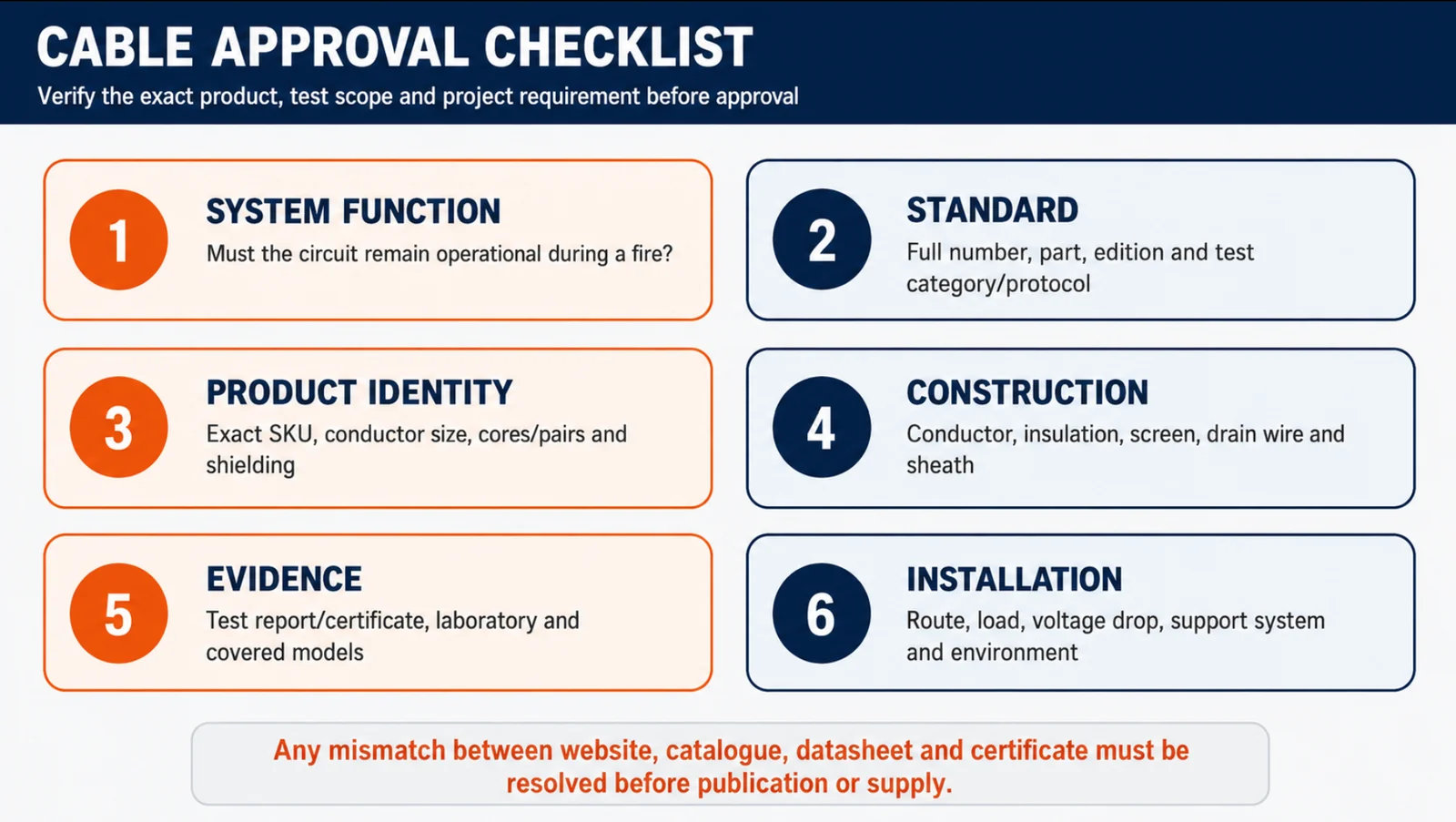
1. Identify the Required System Function
Determine whether the circuit must continue operating during a fire. Critical systems may include fire alarms, voice evacuation, smoke control or other emergency functions. The required performance and test standard should be stated in the approved specification.
2. Confirm the Required Fire-Performance Properties
The specification may require one or more of the following:
- Circuit integrity.
- Limited flame propagation.
- Low smoke density.
- Low halogen acid-gas emission.
- Reduced corrosivity of combustion gases.
- Mechanical-impact performance during fire.
- Fire performance with water exposure.
Do not treat these properties as one combined certification.
3. Verify the Exact Standard
- Full standard number.
- Applicable part.
- Edition or amendment.
- Test category or protocol.
- Cable voltage and overall-diameter scope.
- Any project-specific acceptance criteria.
4. Check the Exact Product Construction
- Product name and SKU.
- Number of cores or pairs.
- Conductor size.
- Shielded or unshielded construction.
- Insulation material.
- Screen and drain-wire construction.
- Sheath material.
- Overall cable construction and diameter.
A test report for one SKU should not automatically be applied to a different conductor size or cable construction.
5. Review the Installation Environment
- Indoor or outdoor installation.
- Electromagnetic interference.
- Cable segregation.
- Mechanical protection.
- Route length and circuit load.
- Voltage-drop limits.
- Installation method.
- Required cable supports and fixing systems.
- System-manufacturer instructions.
Cable performance is only one part of maintaining an operational life-safety circuit. Installation accessories, supports, terminations and the complete system must follow the approved design.
Common Specification Mistakes
Using “Fire-Retardant” and “Fire-Resistant” Interchangeably
This creates uncertainty about whether the requirement is flame propagation or circuit integrity.
Assuming LSZH Means Fire-Resistant
LSZH describes smoke and halogen-related properties. It does not by itself prove that the cable will maintain circuit operation during fire.
Referring Only to a Standard Family
A reference such as “IEC 60331” may be incomplete. The applicable part, edition and scope should be checked.
Copying the Same Standards Across Multiple SKUs
Different conductor sizes, shielding structures or cable constructions should not automatically inherit the same compliance claims.
Selecting Cable Only by Conductor Size
Selection must also consider circuit load, voltage drop, route length, electromagnetic environment, fire-performance requirements and installation conditions.
Using Absolute “Fireproof” Claims
Fire performance is demonstrated under specified laboratory conditions. Marketing language should not imply unlimited resistance to every real-world fire.
How to Verify a Cable Before Approval
Before approving a fire-performance cable, request and compare:
- The latest approved product catalogue.
- The product datasheet.
- The exact product name and SKU.
- The applicable test report or certificate.
- The standard number, part and edition.
- The laboratory or certification body.
- The test scope and acceptance criteria.
- The models and constructions shown in the report.
- The product marking and packaging information.
- Consistency between the website, catalogue, datasheet and certificate.
Stop and clarify
Any mismatch between the website, Catalogue, datasheet, product marking and test document should be resolved before the cable is submitted, approved or installed.
Documentation should be treated as part of the specification, not as an afterthought. Ask the supplier for the full test report rather than a summary certificate, and confirm that the issuing laboratory is accredited for the standard being claimed. Check the issue date, the report number and the name of the manufacturing plant, because a report issued for one production site does not automatically cover another.
Where a project is subject to third-party inspection, keep a single approved submittal package so that the consultant, the contractor and the site engineer all work from the same revision. Storing these documents alongside the project drawings makes future maintenance, audits and any post-incident investigation considerably faster and easier to defend. A short internal note recording who approved the submittal, and on what date, removes most of the ambiguity that appears later on site when a substitution is proposed.
Heizka Fire-Resistant Cable Options
Heizka provides fire-resistant LSZH cable options intended for fire alarm, signalling and related critical circuits. The range includes shielded and unshielded configurations with different conductor sizes.
Final product selection should be based on the approved Heizka Catalogue, verified test documentation, system requirements, circuit calculations, project specifications and consultant approval.
Explore the Heizka Fire-Resistant Cable Range, or review the related fire alarm and emergency communication cabling solutions.
Frequently Asked Questions
Is a flame-retardant cable also fire-resistant?
Not necessarily. Flame-retardant performance concerns limiting flame propagation. Fire-resistant performance concerns maintaining circuit integrity during specified fire-test conditions. Separate evidence is required.
Is every fire-resistant cable also flame-retardant?
Not automatically. A fire-resistant cable may also be tested for flame propagation, but the applicable IEC 60332 report should be checked.
What does circuit integrity mean?
Circuit integrity means that the cable continues carrying electrical power or signals while exposed to the conditions defined by the applicable fire test.
Is LSZH the same as fire-resistant?
No. LSZH relates to smoke and halogen-related properties of cable materials. Circuit integrity must be demonstrated through an applicable fire-resistance test.
What is the difference between IEC 60331 and IEC 60332?
The IEC 60331 series addresses circuit integrity under fire conditions. The IEC 60332 series addresses flame propagation for electrical and optical-fibre cables.
What does BS 6387 CWZ mean?
It refers to defined BS 6387 test protocols involving fire, water and mechanical shock. The designation should only be used when the exact cable has supporting evidence for the claimed protocols.
Can a certificate for one cable size apply to another size?
Not automatically. The test report or certificate must be reviewed to determine the models, conductor sizes and constructions included in its scope.
Which cable should be used for a fire alarm system?
The correct cable depends on the circuit function, required fire-performance standard, route length, voltage drop, electromagnetic environment, installation method and approved project specification.
Choose Cable Performance Based on the Required Function
Fire-resistant and flame-retardant cables both contribute to safer electrical installations, but they address different risks.
Use a flame-retardant cable where the approved design requires limited flame propagation. Use a fire-resistant cable where the circuit is required to continue operating during specified fire conditions.
Where a life-safety circuit requires several fire-performance properties, verify each requirement separately and confirm that the exact product is supported by valid documentation.
Request technical support
Send Heizka the system and circuit type, required standard and edition, shielding requirement, conductor size, circuit voltage and load, route length, installation environment and required technical documents. Final selection remains subject to project and consultant approval.
Request a Cable Specification Review View Heizka Fire-Resistant Cables
References and Source Notes
- BSI — BS 6387:2013, test method for resistance to fire of cables required to maintain circuit integrity under fire conditions
- IEC — IEC 60331-1:2018, circuit-integrity test method for cables exceeding 20 mm overall diameter
- IEC — IEC 60331-2:2018, circuit-integrity test method for cables not exceeding 20 mm overall diameter
- IEC — IEC 60332-1-2:2025, vertical flame-propagation test for a single insulated wire or cable
- IEC — IEC 60332 series, tests on electric and optical-fibre cables under fire conditions
Source use note: this article summarises the publicly available scope of standards. It does not reproduce licensed standards text and is not a substitute for purchasing and consulting the applicable standard.
Image Credits and Reuse Conditions
- Figure 2 (cable tray fire, Sweden): public-domain image by Achim Hering via Wikimedia Commons. Resized for layout. Not a Heizka or IEC test.
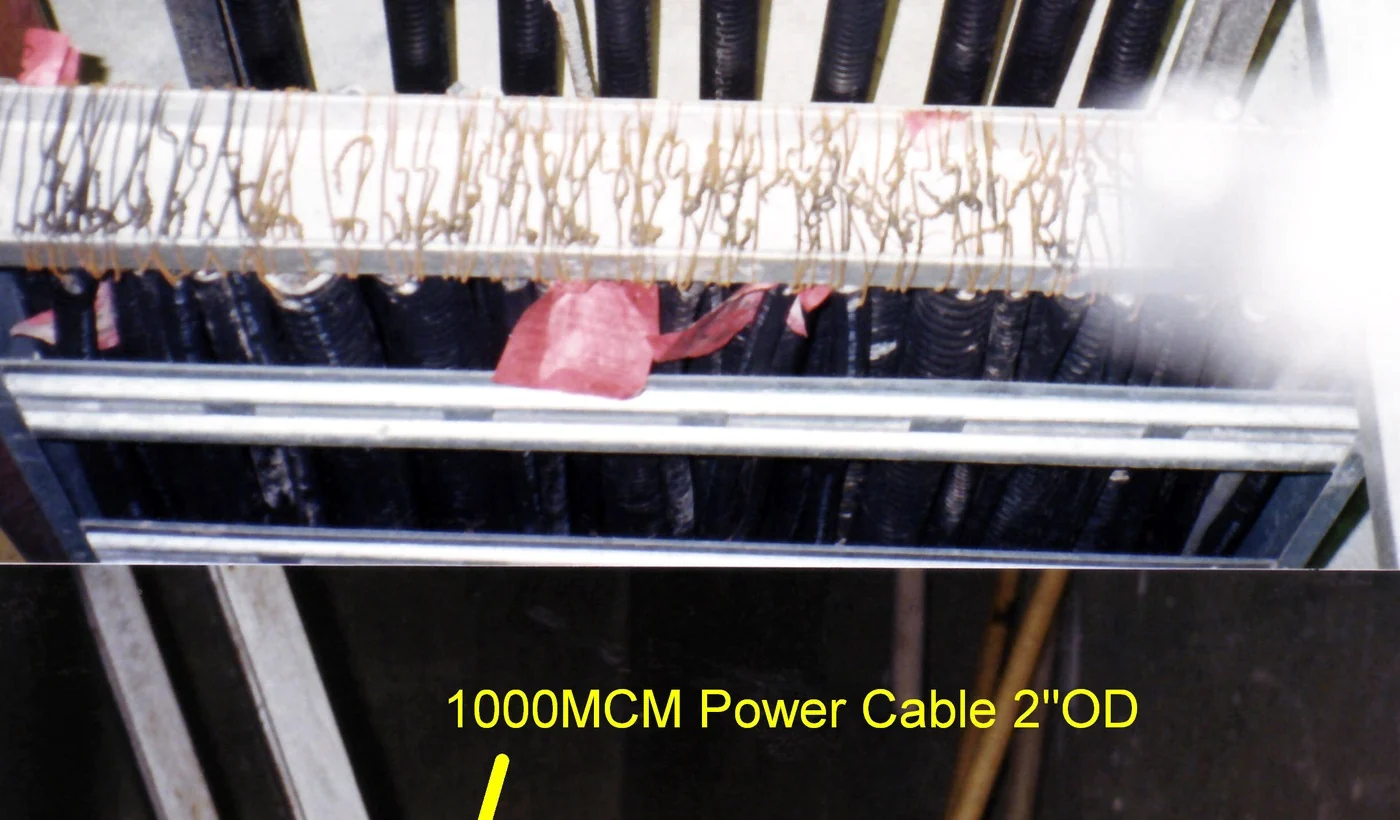
- Figure 4 (power and control cables): public-domain image by Achim Hering via Wikimedia Commons. Resized for layout. Contextual fire-test assembly image.
- Featured illustration and Figures 1 and 3: original diagrams created for Heizka.
Technical Review by John Smith
Cable Product Engineer
12 Years in Structured Cabling & Low Voltage Systems