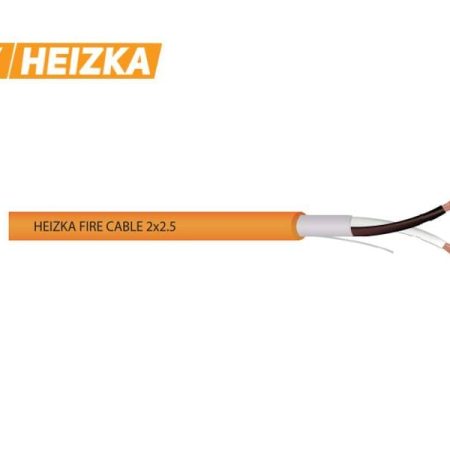
Fire-Resistant Cable 2×2.5 mm²
The 2×2.5 mm² size is the largest cross-section in the Heizka Fire Cable range, specified when current draw or route length, not device count, drives the design. Both variants use stranded bare copper on a 49/0.24 mm construction — equivalent to 14 AWG — with silicone insulation at 100% coverage and an orange LSZH jacket, rated 300 V with 2000 V dielectric strength. Published maximum DC resistance is 7.98 Ω/km at 20 °C, the lowest in the range and roughly a third of the 1.0 mm² figure.
Products in This Size
| Product | Screen | Insulation thickness / diameter | Jacket thickness / OD |
|---|---|---|---|
| Fire Resistant Cable Shielded, LSZH 2×2.5 mm² | Polyester tape + aluminum foil, 100% coverage, drain wire 7/0.18 TC mm | 0.6 ± 0.05 mm / 3.1 ± 0.10 mm | 0.9 ± 0.1 mm / 8.1 ± 0.3 mm |
| Fire Resistant Cable Unshielded, LSZH 2×2.5 mm² | None | 0.6 ± 0.05 mm / 3.1 ± 0.10 mm | 0.9 ± 0.1 mm / 8.0 ± 0.3 mm |
Both are supplied at 500 m per reel with footage markers and cite IEC 60331-1, IEC 60332-1, EN 50200, EN 61034-2, BS 5839-1, BS 6387 and CNS 11175, plus ISO 9001 and RoHS. Published operating temperature ranges are not identical between the two listings, so take that figure from the datasheet for the part number. BS 6387 and EN 50200 are cited without category letters or a PH class; confirm the category, part and edition against the current test report before submitting the cable for approval.
Long Runs and Sustained Load
At 7.98 Ω/km per conductor, a two-core circuit presents about 15.96 Ω/km of loop resistance, or roughly 1.60 Ω per 100 m of route, derived from the published DC resistance at 20 °C. Against about 2.47 Ω per 100 m at 2×1.5 mm² and 4.28 Ω at 2×1.0 mm², this size roughly doubles the route length available for the same end-of-line voltage. That makes it the practical choice for extended notification appliance circuits across large floor plates, voice-evacuation amplifier feeds, sustained 24 V loads to door holders and dampers, and emergency circuits crossing a campus. Size on end-of-line voltage under full alarm load, correct the 20 °C resistance upward for ambient temperature, and confirm current-carrying capacity and grouping derating against the datasheet, since no ampacity table is published for this range.
Handling, Fill and Termination
The trade-off is physical. At 8.0 to 8.1 mm outside diameter with a 0.9 mm jacket wall, this cable occupies materially more conduit and tray cross-section than the smaller sizes, so fill calculations should be redone rather than inherited. Minimum bend radius grows accordingly, and on vertical pulls reel weight and pulling tension become real constraints. At termination, a 49-strand conductor needs a correctly sized ferrule or compression lug; forcing 49 strands into an undersized cage clamp is a common cause of high-resistance joints, which undermines the volt-drop margin the larger conductor was chosen to provide. Verify gland and knockout sizes accept an 8.1 mm jacket.
Shielded or Unshielded
Both constructions carry the same fire-performance intent; the screen addresses electromagnetic interference only. Because this size is often routed alongside power distribution on long runs, the shielded variant is worth considering where separation from feeders, busways or drive cabling cannot be maintained. Physical separation remains the cheapest and most reliable noise control, so treat the screen as a supplement, not a substitute. Bond it at the control panel end only, keep the drain wire continuous, isolate it at the field end, and never mix screened and unscreened cable on one circuit. See shielded versus unshielded fire-resistant cable.
Frequently Asked Questions
Is 2.5 mm² here the same as 14 AWG?
The published construction is 49/0.24 mm at 2.5 mm², stated as the 14 AWG equivalent. Where a specification is written in AWG, confirm the metric cross-section and DC resistance rather than relying on the gauge conversion.
Does the larger conductor improve fire performance?
No. Circuit integrity is demonstrated by test on a specific construction; a larger conductor is not evidence of a higher category, only of better volt-drop margin and current capacity. Read fire performance from the test documentation for that part number. Our article on fire-resistant versus flame-retardant cable covers why the two are assessed separately.
Can I mix 2.5 mm² and 1.5 mm² on the same circuit?
Transitions should be designed and documented, not made in the field. Each cross-section carries its own test evidence, and a junction inside a fire-rated boundary can compromise the assessed system.
Where do I get certificates for a tender?
Datasheets and certificates are available at Project Documents, no registration required.
For pricing, packing options or a submittal pack, send the part number, quantity and destination through contact us. Include the fire-performance category, panel manufacturer and intended installation method so the correct construction can be confirmed against current test documentation before the order is placed.