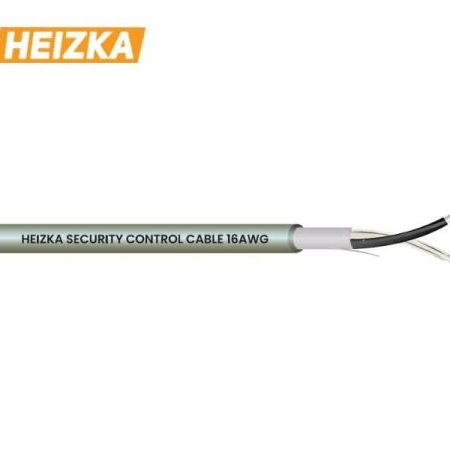
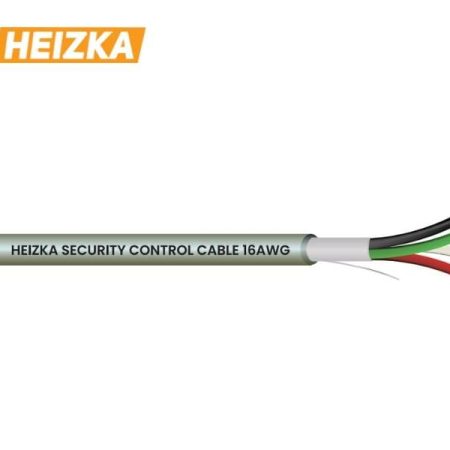
16 AWG Shielded Cable
16 AWG sits between the heavy-current and signal-only ends of the Heizka shielded control range, and it is the size most often specified when a circuit carries a modest load over a moderate distance. Both products in this category are aluminum-shielded twisted constructions with HDPE insulation and a gray PVC jacket, rated 300V and supplied in 305m boxes. They are part of the Heizka Security Control Cable family.
The Middle Gauge and What It Buys You
Each three-step increase in AWG roughly doubles conductor cross-section, so a 16 AWG conductor carries about 60 percent more copper than 18 AWG and about 60 percent less than 14 AWG. In practice that puts 16 AWG in a useful position: it will hold a door strike, a powered sounder, a small DC motor or a shared 12V/24V branch within tolerance across run lengths where 18 AWG would drop too much voltage, without the conduit-fill and termination penalties of stepping all the way up to 14 AWG.
The engineering decision is a two-variable one. Total loop resistance is proportional to run length and inversely proportional to conductor area, and volt drop is that resistance multiplied by load current. Doubling run length doubles the drop; halving conductor area doubles it as well. Where a load allows only a narrow supply window, calculate the drop at the far end before committing to a gauge.
Products in This Category
| Product | Part number | Pairs | Insulation | Shield | Jacket | Rated voltage | Put-up |
|---|---|---|---|---|---|---|---|
| 16AWG Shielded Cable | HEW16S2PC | 1 pair, twisted | HDPE | AL-Shield | PVC, gray | 300V | 305m/box |
| 16AWG Shielded Cable 2 Pair | HEW16S4PC | 2 pair, twisted | HDPE | AL-Shield | PVC, gray | 300V | 305m/box |
Both parts are available in stranded bare copper and solid bare copper. Heizka notes that the stranded conductors provide additional flexibility, and both constructions carry sequential length markings on the jacket. Manufacturing is ISO 9001:2008 and the products are RoHS compliant.
Choosing Between One Pair and Two
The single-pair part is the straightforward choice for a dedicated two-wire circuit: one device, one home run, one screen. The two-pair part is used where a single device needs both a power feed and a separate signal or monitoring pair, or where two related devices share a common route and consolidating them into one jacket reduces the number of cables in the raceway.
Keep the two uses of a two-pair cable electrically compatible. Running a switched inductive load on one pair and a low-level audio or data signal on the other inside the same jacket invites crosstalk that the overall shield does not address, because a single overall screen protects against external interference rather than pair-to-pair coupling within the cable. Where that risk exists, use two separate cables.
Shielding, Grounding and Routing
An aluminum foil screen provides continuous circumferential coverage and is effective against the capacitively coupled electric-field noise that dominates in buildings — the interference picked up from parallel mains runs, fluorescent ballasts and variable-speed drives. To work, the screen has to be continuous and terminated deliberately. Maintain shield continuity through every junction, avoid leaving a long unscreened tail where the jacket is stripped back, and bond the screen to a clean ground at one end only, normally the panel, so no circulating current flows along the shield.
Routing rules are the cheapest form of noise control available. Cross power cabling at right angles rather than running parallel to it, keep separation where a parallel run is unavoidable, and use the twist in the pair as designed by keeping the conductors twisted right up to the termination point.
Frequently Asked Questions
Where does 16 AWG make more sense than 18 AWG?
Any circuit where the calculated volt drop at the far end of the run leaves the load outside its supply tolerance. That is typically longer runs or higher-current devices. For short, low-current detector and signal loops, 18 AWG Shielded Cable is the more economical choice; for the heaviest feeds see 14 AWG Shielded Cable.
Stranded or solid conductor?
Stranded tolerates flexing and repeated dressing inside enclosures better and is easier to route in congested cabinets. Solid is generally preferred for fixed installations terminated once and left undisturbed. Both are offered on these part numbers.
Are these cables rated for outdoor use?
No. Heizka lists these constructions for indoor applications, including security remote control, intercom, audio, door controllers, proximity sensors, keypads, access control and smoke detectors.
Can I order a jacket color other than gray?
The catalogued put-up is a gray PVC jacket. Contact us to discuss project-specific requirements and volumes.
To specify 16 AWG for a project, confirm gauge, pair count, conductor type and quantity, then review the published data in our documents library or read our how to buy page. Contact us for a quote and our team will confirm lead time and packaging.