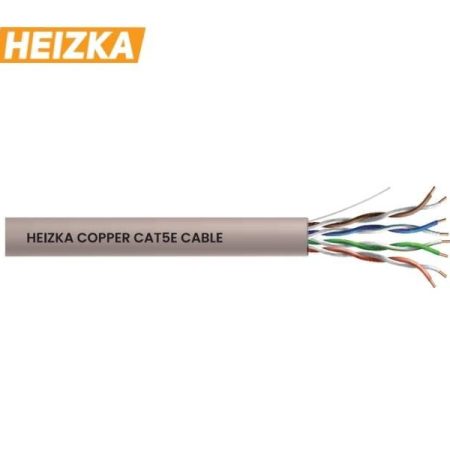
Cat5e Network Cable
Cat5e is the entry grade of the modern balanced twisted-pair family and remains the most widely installed copper cable in service. It is specified to support 1000BASE-T Gigabit Ethernet over a 100 m channel and, in the Heizka construction, is published with an operating frequency of 1–100 MHz extended to 350 MHz. Where a project needs reliable gigabit connectivity to endpoints rather than headroom for 10 Gigabit, Cat5e is still the correct and economical specification.
What Distinguishes Cat5e
Cat5e corresponds to Class D cabling in ISO/IEC 11801. Compared with the obsolete Cat5, the enhanced grade tightened near-end crosstalk, return loss and delay skew limits specifically so that all four pairs could be driven simultaneously in both directions, which is what 1000BASE-T requires. It does not have the pair-separation geometry or the bandwidth headroom of Cat6 and above, so it is not a 10GBASE-T grade. The practical ceiling is gigabit to the outlet, plus power.
Published Construction and Performance
The Heizka Copper Cabling System CAT5E is built as U/UTP CAT5E 4x2x24AWG on 24 AWG solid bare copper conductors with HDPE insulation. Published electrical characteristics are impedance of 100 Ω ±15% across 1–100 MHz, DC resistance below 9.38 Ω/100 m, operating capacitance of 5.6 nF/100 m or less, nominal velocity of propagation of 69%, and propagation delay of 45 ns or less. Jacket diameter is 5.1 ± 0.3 mm, which is the smallest in the Heizka copper range and a meaningful advantage where conduit or pathway fill is the binding constraint.
| Part number | Jacket | Color | Packaging |
|---|---|---|---|
| HEC5EU3PE | PE | Black | 305 m / box |
| HEC5EU1CM | CM | Blue | 305 m / box |
| HEC5EU1PC | PVC | Blue | 305 m / box |
| HEC5EU5LZ | LSZH | Orange | 305 m / box |
Typical Applications
Published applications are 1000BASE-T Gigabit Ethernet, PoE and PoE+ powered devices, and structured premises cabling to Class D / Cat5e. In practice this covers IP telephony, fixed desktop and thin-client positions, IP cameras and access control readers, door controllers, digital signage, and building management endpoints. It is also the common choice for adds, moves and changes on floors already cabled to Cat5e, where matching the installed base keeps channel performance consistent.
Because PoE loads run current through the same conductors that carry data, bundle size and ambient temperature matter. The published installation temperature range is 0°C to +70°C and the operating range is −20°C to +70°C. Insertion loss rises with conductor temperature, so large bundles carrying continuous PoE in a warm ceiling void deserve a derating check even at gigabit speeds.
Standards Referenced
The Cat5e system is published against ISO/IEC 11801, ANSI/TIA/EIA-568-C.2, IEC 61156-5 and EN 50173-1, and is RoHS and CE certified. Heizka as a manufacturer states certification to UL, ETL, RoHS and CE and compliance with FCC, TIA and TAA requirements. For LSZH selection, note that IEC 60332 governs flame propagation along a cable, which is a different property from circuit integrity under fire; see fire-resistant cable versus flame-retardant cable if your specification touches life-safety circuits.
Frequently Asked Questions
Can Cat5e carry 2.5GBASE-T or 5GBASE-T?
The IEEE 802.3bz standard was written to run 2.5GBASE-T over installed Cat5e in many real-world channels, and 5GBASE-T over Cat6. That is an installed-base allowance validated by field testing, not a rating of the cable. For new work where multi-gigabit is a requirement, specify Cat6 or Cat6A instead.
Why is 350 MHz mentioned when Cat5e is a 100 MHz category?
Category 5e is defined and tested to 100 MHz. The extended figure describes measured cable performance above the category limit and provides margin against installation variables; it does not reclassify the cable to a higher category. Certification testing is still performed to the Cat5e limit lines.
Which jacket should I order?
Choose by the pathway and local code. CM and PVC jackets cover general commercial interiors, PE is offered in black for the harder-wearing variant, and LSZH in orange is intended for enclosed occupied spaces where smoke density and halogen content are regulated. All four are packaged 305 m per box.
Does the 100 m limit include patch cords?
Yes. The 100 m channel comprises up to 90 m of solid horizontal cable plus patch and equipment cords. Solid conductor cable of this type is intended for the fixed horizontal run and should not be used for flexing patch cord applications.
To confirm availability, packaging and pricing on any HEC5E part number, or to compare Cat5e against a higher grade for a specific floor plan, review the wider copper cable range or contact us for a quote.