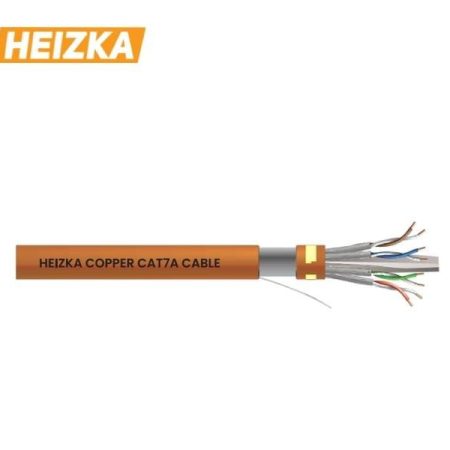
Cat7 S/FTP Network Cable
S/FTP is the fully shielded end of the twisted-pair range: every pair carries its own foil screen and the whole assembly sits inside an overall braid. Heizka’s product in this category is the Copper Cabling System CAT7A, published as S/FTP CAT7A 4x2x23AWG at 1–1000 MHz, Class FA. It is specified where electrical noise, pair-to-pair isolation or long-term bandwidth headroom drive the design rather than first cost.
The Screening Architecture
The distinction that matters is individual screening. In S/FTP, each of the four pairs is wrapped in its own foil, which suppresses crosstalk between pairs by physical isolation rather than by relying on twist ratios and transceiver cancellation. The overall braid then handles common-mode ingress and egress from outside the cable. That combination is why Class F and FA specify far higher crosstalk margins than any unshielded grade, and it is what makes the construction suitable for environments where an unscreened cable would be marginal.
Insulation is physical foaming PE in a skin-foam-skin structure. Foaming lowers the effective dielectric constant, which allows the published nominal velocity of propagation of 78% — well above the 65–69% of the solid-insulation grades in the range — and contributes to the low propagation delay of 25 ns or less.
Published Specifications
Conductors are 23 AWG solid bare copper. Pair colors are white/blue, white/orange, white/green and white/brown. Published jacket options are PVC and LSZH, at a jacket diameter of 8.1 ± 0.3 mm. Impedance is tiered: 100 Ω ±15% from 1 to 100 MHz, ±22% from 100 to 250 MHz and ±25% from 250 to 500 MHz. DC resistance is below 9.38 Ω/100 m and operating capacitance is 5.6 nF/100 m or less. Tensile strength is 110 N and minimum bend radius is ten times the maximum jacket diameter. Operating temperature range is −20°C to +70°C (−4°F to 158°F). Packaging is 305 m per box. Standards referenced are IEC 61156, ISO/IEC 11801, TIA 568C.2, IEC 60574 and EN 50173-1, with RoHS and CE certification. PoE, PoE+ and PoE++ are supported.
| Part number | Conductor | Packaging |
|---|---|---|
| HEC7ASF3PE | 23 AWG | 305 m / box |
| HEC7ASF1CM | 23 AWG | 305 m / box |
| HEC7ASF1PC | 23 AWG | 305 m / box |
| HEC7ASF5LZ | 23 AWG | 305 m / box |
Bonding and Grounding: the Decisive Detail
A shielded cabling system is only as good as its bonding path. Both the individual pair foils and the overall braid must be terminated to shielded connecting hardware, carried through screened patch panels, and bonded to the rack and on to the telecommunications bonding backbone in accordance with the applicable grounding standard. Discontinuities create antenna structures and can make a screened installation perform worse than a well-installed unshielded one. Plan the grounding topology before the first cable is pulled, budget for shielded jacks and cords, and verify shield continuity during field certification. The comparison in shielded versus unshielded cable makes the same argument for other cable families.
Where It Is Specified
Typical settings are industrial floors with variable frequency drives, hospitals and imaging suites, broadcast facilities, transport infrastructure, and installations where a long service horizon justifies cabling beyond current switch capability. The published 1000 MHz characterization gives substantial margin over the roughly 400 MHz that 10GBASE-T occupies. LSZH jacketing suits enclosed occupied spaces with smoke and halogen limits; note that flame retardance is a separate property from circuit integrity under fire, as covered in fire-resistant versus flame-retardant cable.
Frequently Asked Questions
What is the difference between Cat7 and Cat7A?
Both are ISO/IEC constructions. Class F is characterized to 600 MHz and Class FA to 1000 MHz. The Heizka product here is the CAT7A cable, published at 1–1000 MHz, Class FA.
Does Cat7A terminate on standard RJ45 outlets?
Class F and FA are defined in ISO/IEC 11801 with non-RJ45 interfaces such as GG45 and TERA to achieve their full frequency characterization. In practice much Cat7A cable is terminated on shielded RJ45 hardware, in which case the channel certifies to the grade of that hardware, typically Class EA. Decide the connector strategy at design stage; it determines what you can certify.
How does it compare with Cat6A for a normal office fit-out?
For a conventional commercial floor, Cat6A is usually the right specification and is easier to install. S/FTP is justified by the electromagnetic environment, by emission-security requirements, or by an unusually long service life.
Does the larger diameter affect pathway design?
Yes. At 8.1 mm the jacket is the largest in the Heizka copper range, so conduit and tray fill must be recalculated rather than carried over from a Cat6 design. The 110 N tensile limit and ten-times bend radius also apply during pulling.
For part numbers, shielded accessory matching or project pricing, see the copper range or contact us for a quote.